The question is almost always framed the wrong way round. People ask “is my iPhone too old?” when the useful question is “what exactly is wrong with it?”
A four-year-old iPhone with a worn battery is a good phone with a consumable part at end of life. A two-year-old iPhone with a corroded board and a cracked screen may not be worth saving. Age tells you very little on its own.
Here is the framework we actually use when someone asks us this across the counter.
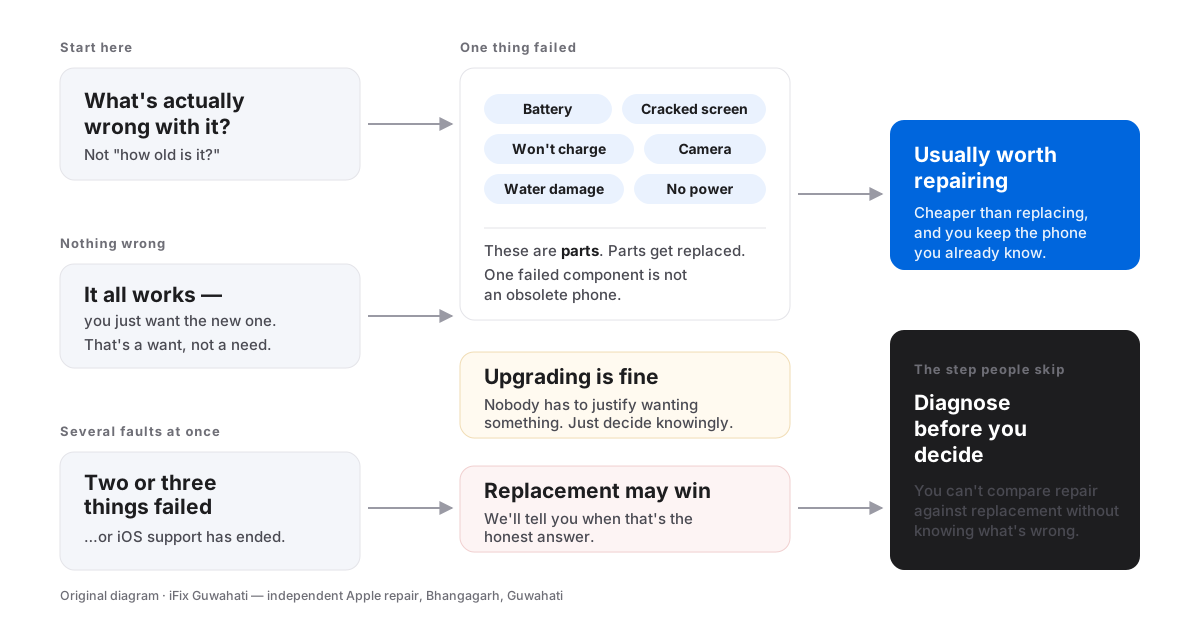
Our own decision flow — the same one we work through across the counter.
Step 1: Identify the fault
Work out which row you are in. If more than one applies, note that — it matters in Step 3.
| Symptom | Likely cause | Repairable? |
|---|---|---|
| Dies by afternoon, shuts down at 20–30% | Worn battery | Yes — routine |
| Feels slow, apps reload constantly | Usually the same worn battery | Yes |
| Cracked glass, ghost touch, lines | Display assembly | Yes |
| Only charges at certain angles | Port debris or worn port | Yes — often just cleaning |
| Cracked back panel | Back glass | Yes |
| Blurry or shaking camera | Camera module | Usually |
| Got wet | Liquid damage | Depends — act fast |
| No power at all | Board-level fault | Often, at component level |
| Nothing — you just want the new one | — | Not a repair question |
That last row is worth taking seriously. If nothing is broken and you simply want the new camera, that is a legitimate reason to buy a phone. Nobody needs to justify wanting something. This guide is for the other rows.
Step 2: Apply the single-fault test
One failed component on a phone that is otherwise sound is almost always worth repairing.
This is the rule that saves people the most money, and the one most often ignored.
A battery is a consumable. It is designed to wear out. Replacing one is closer to changing tyres than to rebuilding an engine — and yet “my battery does not last” is the most common reason we hear for buying a new phone.
The same logic applies to a cracked screen or a failed charging port. These are parts. Parts can be replaced.
Step 3: Apply the multiple-fault test
Where it changes:
- Two significant faults — worth quoting, but compare the total against the phone’s value
- Three or more — replacement usually wins
- Serious board damage on an older phone — often not economic, and we will say so
- Extensive corrosion from water damage — sometimes unrecoverable at any price
The maths is not complicated: total repair cost versus what the phone is worth to you working, plus how many years of use you expect from it.
Step 4: Check the things that genuinely date a phone
Separate from faults, two things do eventually make a phone worth retiring:
Software support. When an iPhone stops receiving iOS updates, it stops receiving security fixes. That is a real reason to move on, and it arrives many years after purchase.
Your actual needs. If you need a camera your phone does not have, no repair fixes that.
Neither of these is a fault. Both are legitimate reasons to upgrade.
What we will not tell you
A specific price, before seeing the device. Repair cost depends on the model, the fault, the part required and the condition of the device. Two phones with “a cracked screen” can be entirely different jobs once opened — one has a straight frame, the other is bent and will not seat a new display properly.
Anyone quoting you a firm price over the phone, sight unseen, is either guessing or planning to revise it later.
What we do instead: diagnose the fault, explain what we found, and give you a written quote before any work begins. Diagnosis carries a fee, and that fee is waived if you go ahead with the repair.
If replacing is the answer and you are looking at the second-hand market, run through the 12 checks to do before you pay first.
The decision, summarised
Repair when: one component has failed, the body is sound, the phone still gets iOS updates, and it otherwise does what you need.
Replace when: several major things have failed at once, the board is badly damaged, support has ended, or your requirements have genuinely outgrown the device.
Diagnose when: you do not actually know which of those you are in. Which, honestly, is most people.
Before you spend on a new iPhone, find out what is really wrong with the one you have. Send us your model and a description of the fault, and we will tell you straight whether it is worth fixing. iPhone repair in Guwahati → · Talk to us →